Ginseng in skincare: A look at ginseng, rice and green tea
A root, a rice grain, a tea leaf: Lee looks at the preparation behind the plant name and explains what helps with the selection.

Ginseng in skincare: A look at ginseng, rice and green tea
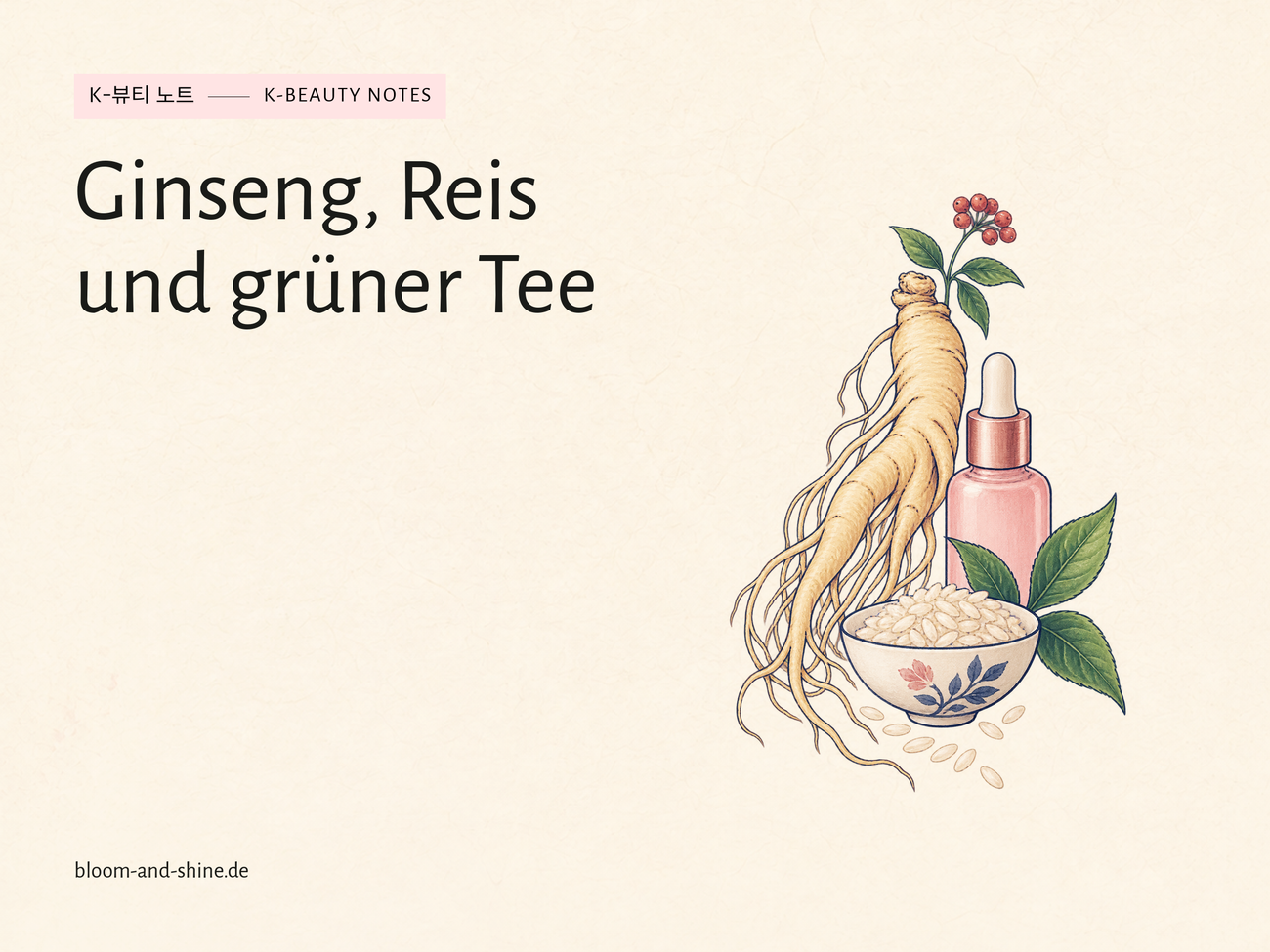
A root on the essence, rice grains on the toner and a tea leaf on the next bottle: When it comes to herbal ingredients, the packaging sometimes seems more familiar than the ingredient list. It says Panax Ginseng Root Extract or Camellia Sinensis Leaf Extract.
The names tell something about the origin of an ingredient. However, a few pieces of information are still missing for the selection. Which part of the plant was used? In what form is it in the product? And do you actually like the care it comes with? We start with ginseng and use rice and green tea for comparison.
Ginseng is not the same on every ingredient list
Ginseng can appear in a product, for example as root water, root extract or fermented ingredient. This can be clearly seen in the ingredient list of the Ginseng Essence Water from Beauty of Joseon : There are several differently named ginseng ingredients.
A large proportion of plants on a package therefore does not indicate how much of an individual substance being examined is contained in it. Root water does not indicate the concentration of specific ginseng components. The number of ginseng entries is also not a measure of effectiveness.
Ginseng doesn’t have to mean heavy cream. If you like thin care, you can get to know the plant in an essence; If you are looking for a richer care feeling, you are more likely to use a cream.
What a study on ginseng can show
There are studies with ginseng preparations on human skin. In a small controlled study with 23 participants, a cream containing enzymatically modified Panax ginseng was examined. In certain measurements of eye wrinkles and skin roughness, it performed better than the comparison cream. Study on enzymatically modified Panax ginseng
What is interesting is the precise description: a specific preparation and a specific cream were examined. The result cannot be transferred to every ginseng water, every essence or a completely different extract mixture. When reading a product description, it helps to ask whether the receipt belongs to the finished product or just an ingredient.
If you are primarily concerned with visible lines, you can find the article What wrinkles do we have on our face? an initial orientation to the different names.
A product example for a light essence
The Beauty of Joseon Ginseng Essence Water is a liquid care product to be applied after cleansing. In addition to ginseng ingredients, the shop’s list of ingredients includes glycerin, niacinamide and panthenol. The light, liquid texture makes it a nice place to start if you want to try out ginseng care and continue using your usual cream.
The manufacturer describes distributing with your hands or a cotton pad. So if you don’t like cotton pads, you can stick with your hands. Follow the instructions on your package.
There is a separate article about niacinamide. If the terms Toner and Essence are giving you a headache, our overview Toner and Essence: What’s the difference? .
Rice: Consider extract and oil separately
The distinction is also useful for rice. A rice bran oil ingredient is different than a watery rice extract. A research result on an oil preparation does not automatically answer the question about a rice toner.
A study developed a special emulsion with rice bran oil and tested, among other things, its moisturizing properties on volunteers. The results describe this emulsion. They are not proof that every rice extract has the same effect. Bernardi et al.: Emulsions with rice bran oil
To try it out for the first time, all you need is a texture that you like: an essence to pat in or a cream to finish. If you have known intolerances, the complete list of ingredients remains important.
Green tea: The formulation is also being investigated
When it comes to green tea, research often focuses on certain extracts or substances obtained from them. For example, in a controlled facial study with 29 participants, green tea extract enclosed in chitosan microparticles was tested in a cream. Individual skin measurements improved compared to the comparison cream. Study on encapsulated green tea extract
That sounds much more special than “green tea” – and it is. It is precisely this difference that prevents an interesting research approach from becoming a blanket promise for all tea serum bottles. A tea infusion from the kitchen also does not correspond to this formulation.
You may of course like a green tea toner because its texture feels pleasant. You don’t have to attribute an effect to it that hasn’t been studied. Good advice helps you to keep the two apart: what you value about care and what can be proven professionally.
Three ingredients, no ranking
Between ginseng, rice and green tea, no winner can be determined from these different studies. They were tested in different formulations and under different conditions. Very practical questions remain when making your selection: Should care be easy? Which products would you like to continue using? Is there a known intolerance?
If you would like to classify the plant terms alongside other active ingredients, you will find the common overview in Ingredients in K-Beauty. It also leads to humectants, ceramides and the other ingredients in this range.
What we know for sure
- Plant name, plant part used and type of preparation are different information.
- Ginseng water and a studied ginseng extract are not automatically interchangeable.
- The small studies mentioned examined specific formulations.
- No general ranking of the three ingredients can be derived from various studies.
Sources
- Beauty of Joseon: Ginseng Essence Water – Ingredients and Application
- Study: Enzymatically modified Panax ginseng in a cream
- Bernardi et al.: Rice bran oil in a cream Emulsion
- Study: Green tea extract in chitosan microparticles
Product information checked on September 8, 2026.