AHA, BHA and PHA: Which peeling suits your skin?
Rough skin, blackheads or looking for a mild peeling: Lee will help you classify AHA, BHA and PHA and read the appropriate product instructions.

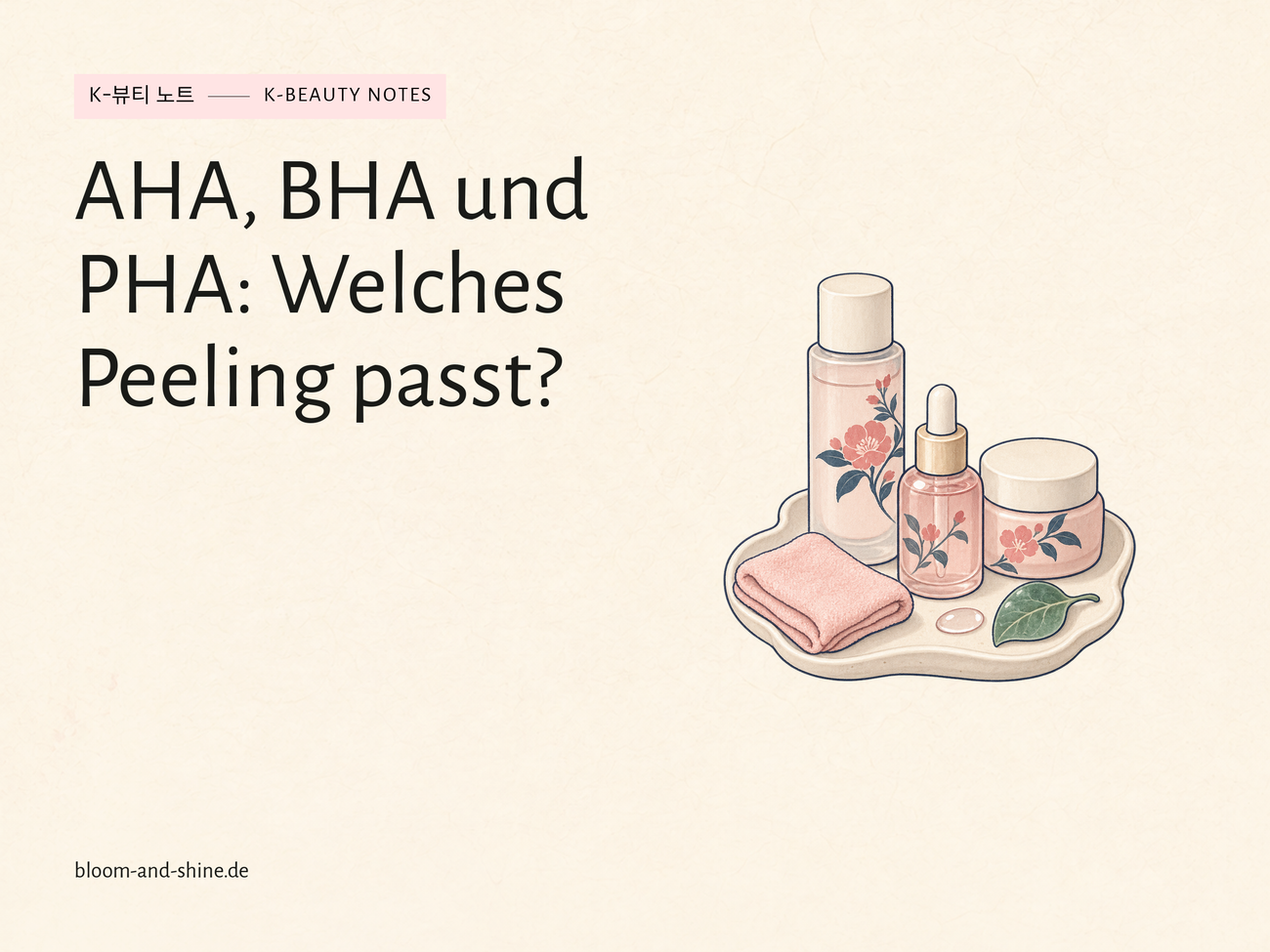
AHA, BHA and PHA: Which peeling suits your skin?
Today, a peeling can be as liquid as water. It is found in toners, serums or already soaked pads, and sometimes the word “peeling” is only on the back. If AHA, BHA and PHA are added to the mix, what should have been a small care step quickly turns into longer research.
Let’s start with your concern: Does the skin feel rough? Do blackheads bother you? Or are you primarily looking for something that sensitive skin tolerates well? More depends on this than the number on the label. And when your skin is feeling good right now, it doesn’t need an extra exfoliation step just because it’s in a routine.
What an acid peeling does
Dead horny cells continually dissolve on the surface of the skin. A chemical peel supports this process through its ingredients; A mechanical peeling works, for example, with granules or a brush. Using both in addition is not necessary for thorough care. The American Academy of Dermatology explains the differences and the risk of intensive peels .
Even a gentle texture can contain effective acids. A watery toner is therefore not automatically a moisturizing toner that you apply generously in several layers. Look at the active ingredient advertised and the instructions for use.
AHA: If the surface feels rough
The alpha hydroxy acids include glycolic acid and lactic acid. In the ingredient list you will find them as Glycolic Acid and Lactic Acid . AHAs can loosen the bond between superficial horny cells and support their detachment. That’s the idea behind making your skin feel smoother. DermNet describes this effect of AHAs .
If you are primarily concerned about an unevenly rough surface, an appropriately formulated AHA product may be an option. Rough, flaky skin can also be dry and irritated. If it is already tight or burning, I would first simplify the previous care. In the article about the skin barrier and the feeling of tightness or burning we take a closer look at this situation.
BHA: Take a closer look at blackheads
In skincare, BHA usually means salicylic acid, on the ingredient list Salicylic Acid . It has a keratolytic effect: it supports the loosening of horny material and can therefore be helpful for clogged pores. DermNet explains the properties and application of salicylic acid .
This makes BHA a possible approach if blackheads are your actual concern. However, the small dots on the nose are not all blackheads. You will also often see normal sebaceous threads. An acid does not have to remove every visible spot. Our article about large pores, sebum and blackheads will help you classify these differences.
PHA: A possible alternative for sensitive skin
PHA stands for polyhydroxy acids. A common example is Gluconolactone . In a twelve-week clinical comparison study, a gluconolactone routine was better tolerated than the glycolic acid routine examined; Burning and stinging were more severe in the AHA group. Researchers from a cosmetics manufacturer were involved in the study by Edison and colleagues .
PHA may therefore be worth considering if you are looking for a peel and respond quickly to care. The finished product remains crucial. Comparing two routines does not guarantee that each PHA formulation will be comfortable for your skin. On already irritated skin, I would also skip a peeling that is described as mild for now.
Why two percent doesn’t say everything
Type of acid, concentration, pH value and the rest of the recipe influence the effect of a peeling. Two products with the same percentage can therefore behave differently. And citric acid in an ingredients list can also be used to adjust pH without the product being intended as a peeling. The US FDA describes these connections on AHAs in cosmetics .
To make the selection, I would therefore read three things together: the care requirements, the complete product description and the instructions. The highest number is not a sensible shopping goal.
A concrete example: Anua BHA 2% Gentle Exfoliating Toner
According to the manufacturer, the Anua BHA 2% Gentle Exfoliating Toner contains two percent salicylic acid as well as panthenol and ceramides, among other things. This makes it a BHA peeling in toner form. The additional ingredients do not automatically make salicylic acid non-irritating.
Anua recommends starting slowly and monitoring the skin reaction. Adjust the amount, frequency and application according to the instructions in your package. Such a toner stays on the skin; Other instructions apply to a peeling that needs to be washed off.
At the beginning I would keep the rest of the process familiar: cleansing, the selected peeling according to the instructions and a moisturizer that is already well tolerated. If you already use retinol or other exfoliating products, check this combination beforehand. The AAD notes that additional exfoliation with retinol or medical acne care, among other things, can increase irritation.
Sun protection is one of them
Increased sensitivity to the sun has been proven for AHAs. The FDA recommends sunscreen, protective clothing, and limited sun exposure during use and for one week afterward. This statement refers to AHAs; it is not blanket evidence for every acid group. Anua also mentions sun protection in its product instructions.
If a peeling burns unpleasantly or causes significant irritation, pause. Good care can be recognized by the fact that you can cope with it in everyday life. You can find further guidance on the names on your products in our overview of ingredients in K-Beauty.
What we know for sure
- AHA, BHA and PHA are different acid groups; the finished recipe counts.
- Salicylic acid can be helpful for clogged pores. Normal pores remain visible.
- Application and frequency depend on the specific product and its tolerability.
- Already irritated skin needs a break from peeling; AHA application requires special attention to sun protection.
Sources
- American Academy of Dermatology: How to safely exfoliate at home
- DermNet: Alpha hydroxy acid facial treatments
- DermNet: Salicylic acid
- Edison et al. (2004): Clinical comparison of a PHA and an AHA routine
- FDA: Alpha Hydroxy Acids
- Anua: BHA 2% Gentle Exfoliating Toner
Technical and product information checked on September 8, 2026.
How often should you use AHA or BHA?
A fixed number of weeks for each product would be too rough. Concentration, pH value, other active ingredients and your skin make a difference. Start less often than the maximum possible use, do not use several peelings in the same evening and take a break if there is burning or significant flaking.
An acid peeling does not replace sun protection. If you are unsure about which ingredient is in your product, Understanding Ingredients will help you; You can ask an individual cosmetic question via Ask Thu .
Would you like to try a liquid care step? With our toners for impure skin you will also find care for the days between your peeling evenings. Moisture is often a more pleasant addition than another acid.