What wrinkles do we have on our face?
A face carries a small dictionary. There are transverse lines on the forehead. The frown line sits between the eyebrows, even when no one is angry. And the Korean 팔자주름 has...

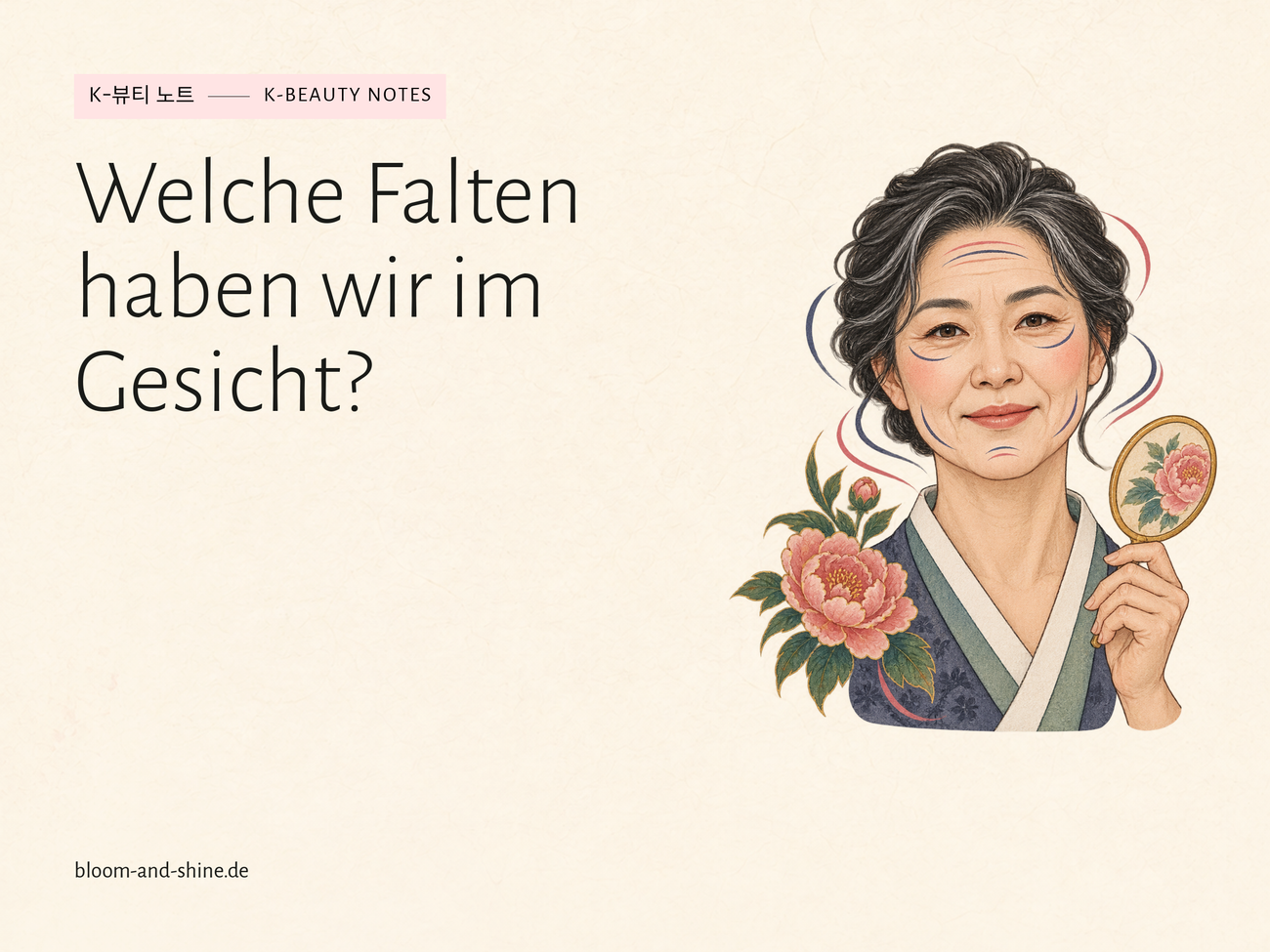
What wrinkles do we have on our face?
A face carries a small dictionary.
There are transverse lines on the forehead. The frown line sits between the eyebrows, even when no one is angry. And the Korean 팔자주름 has less to do with fate than its name suggests.
Let’s take a closer look. Not every line is the same type of fold – and not every German term has a poetic counterpart in Korean.
Wrinkle, furrow or facial expression?
Some lines only become visible when we laugh, blink or wrinkle our nose. They are referred to as dynamic wrinkles or expression wrinkles .
If they remain visible even on a relaxed face, they are referred to as static wrinkles . Other lines are more strongly caused by the shape of bones, fat pads and connective tissue. When viewed more closely, nasolabial and marionette folds are more like lines or furrows than small surface wrinkles.
The names primarily describe where a line lies and what it looks like. They are not a diagnosis.
From forehead to neck
Forehead wrinkles – 이마 주름
이마 means forehead, 주름 means wrinkle. This usually means horizontal lines that become clearer when you raise your eyebrows.
Frown line – 미간 주름
미간 is the area between the eyebrows. The German frown line is therefore simply called 미간 주름 : wrinkle between the eyebrows. It may appear as a single line, as two parallel “11” lines, or in some other pattern.
Eye wrinkles and crow’s feet – 눈가 주름 and 눈꼬리 주름
눈가 주름 is the broad term for wrinkles around the eyes. 눈꼬리 주름 describes more precisely the lines at the outer corner of the eye – what is called crow’s feet in German.
Very fine lines are called 잔주름 in Korean. The word can be used anywhere on the face, but it is often found together with 눈가 , the eye area.
Bunny lines or wrinkles on the bridge of the nose – 콧등 주름
The fine transverse or slanted lines on the bridge of the nose are often called “bunny lines” in the beauty sector. The understandable Korean expression is 콧등 주름 : wrinkles on the bridge of the nose.
Nasolabial folds – 팔자주름 or 코입술주름
These lines run from the wings of the nose towards the corners of the mouth. In everyday Korean life they are usually called 팔자주름 .
The name refers to the character 八 , which looks like a wide-open eight. The two folds on the left and right of the nose are reminiscent of this shape. The medical descriptive term 코입술주름 literally means nose-lip fold and corresponds to the nasolabial fold.
Marionette lines – 마리오네트 주름
Marionette lines extend from the corners of the mouth downwards towards the chin. In Korean, the loan word 마리오네트 주름 is often used for this. More generally, there can also be talk of 입꼬리 주름 , wrinkles at the corner of the mouth.
Pleated wrinkles or lip wrinkles – 입술 세로 주름
This refers to fine vertical lines on and above the lip. 입술 세로 주름 describes them directly as vertical lip wrinkles. 입 주변 주름 is broader and means wrinkles around the mouth.
Some beauty offers also call them 바코드 주름 , i.e. “barcode wrinkles”. This is a descriptive everyday and marketing term, not an anatomical term.
Strawberry chin – 자갈턱 or 호두주름
The so-called strawberry chin is not a single wrinkle. When the chin muscle contracts the skin, it can create an uneven, dotted surface.
In Korean, this image is often called 자갈턱 , literally pebble or gravel chin. 호두주름 , walnut fold, is also used. So different countries see different foods and landscapes in the same chin.
Neck folds – 목 주름
목 means neck. 목 주름 is the collective term for horizontal or vertical neck folds. As in the face, the name initially only says something about the place, not about the cause.
Two terms that are not wrinkles
Tear trough – 눈물고랑
The tear trough runs diagonally downwards from the inner corner of the eye. 눈물고랑 literally means tear furrow. It is an anatomical depression and is not the same as a fine lower eyelid fold.
Aegyo-sal – 애굣살
애굣살 refers to the small bulge directly under the lower eyelid, which can become more noticeable when smiling. In Korean beauty contexts, it is often seen as a friendly or youthful-looking trait.
It is neither a wrinkle nor automatically a tear bag. The spelling is also interesting: According to the National Institute of Korean Language, 애굣살 is the correct form, not the commonly read combination 애교살 .
What skincare can do – and what it can’t
Moisturizing can temporarily make dry, fine lines appear less noticeable. Daily UV protection makes sense because ultraviolet radiation is an important external factor in skin aging.
However, a cream cannot “fill” deep furrows or lift sunken tissue structures. Before you choose an active ingredient for a line, you should first know whether you are talking about dryness wrinkles, a facial wrinkle or a structural wrinkle.
And one more thing: a face without lines is not a medically normal condition. Above all, it would be a face that has moved as little as possible.
You can find a selection of moisturizing, retinol and peptide care products in our collection Reduce wrinkles .
Sources
- National Institute of Korean Language: Dictionary entry 주름
- Korean Dermatological Association: Classification and Korean names of facial wrinkles
- National Institute of Korean Language: correct spelling of 애굣살
- Annals of Dermatology: static and dynamic crow’s feet wrinkles
- Annals of Dermatology: Photoaging – development, prevention and treatment
- Journal of the Korean Society of Laryngology, Phoniatrics and Logopedics: Korean terms for wrinkles on the lower face
Continue with your care
- Discover care Promote firming
- Discover care Peptide+
- Your selection guide Find your routine