The history of K-Beauty
A cushion compact fits in a handbag. His story needs a little more space. Today, we encounter K-Beauty in small bottles, sheet masks, and carefully layered routines. The K before Beauty is...

The history of K-Beauty
A Cushion Compact fits in a handbag. His story needs a little more space.
Today we encounter K-Beauty in small bottles, sheet masks and carefully layered routines. The K before Beauty is comparatively young. The preoccupation with skin, hair and appearance on the Korean peninsula is much older.
However, there is no straight line between the two. There were changing beauty ideals, trade and colonial times, wars, laboratories, pop culture and very clever marketing. Let’s take a closer look.
Before Beauty got a K
Traces of early Korean cosmetics culture can already be found in depictions from the Three Kingdoms period. Carefully shaped eyebrows, colored lips and made-up faces appear on wall paintings.
Back then, cosmetics were not just decoration. She was able to make rank, belonging and an ideal of well-groomed appearance visible. The means people actually used differed depending on time, region and social position.
After all, the past did not have a consistent morning routine.
Goryeo: Powder, Brows and Celadon
During the Goryeo period from 918 to 1392, a rather fair, reserved complexion became more important. Facial powder and narrow eyebrows reminiscent of willow leaves have been handed down.
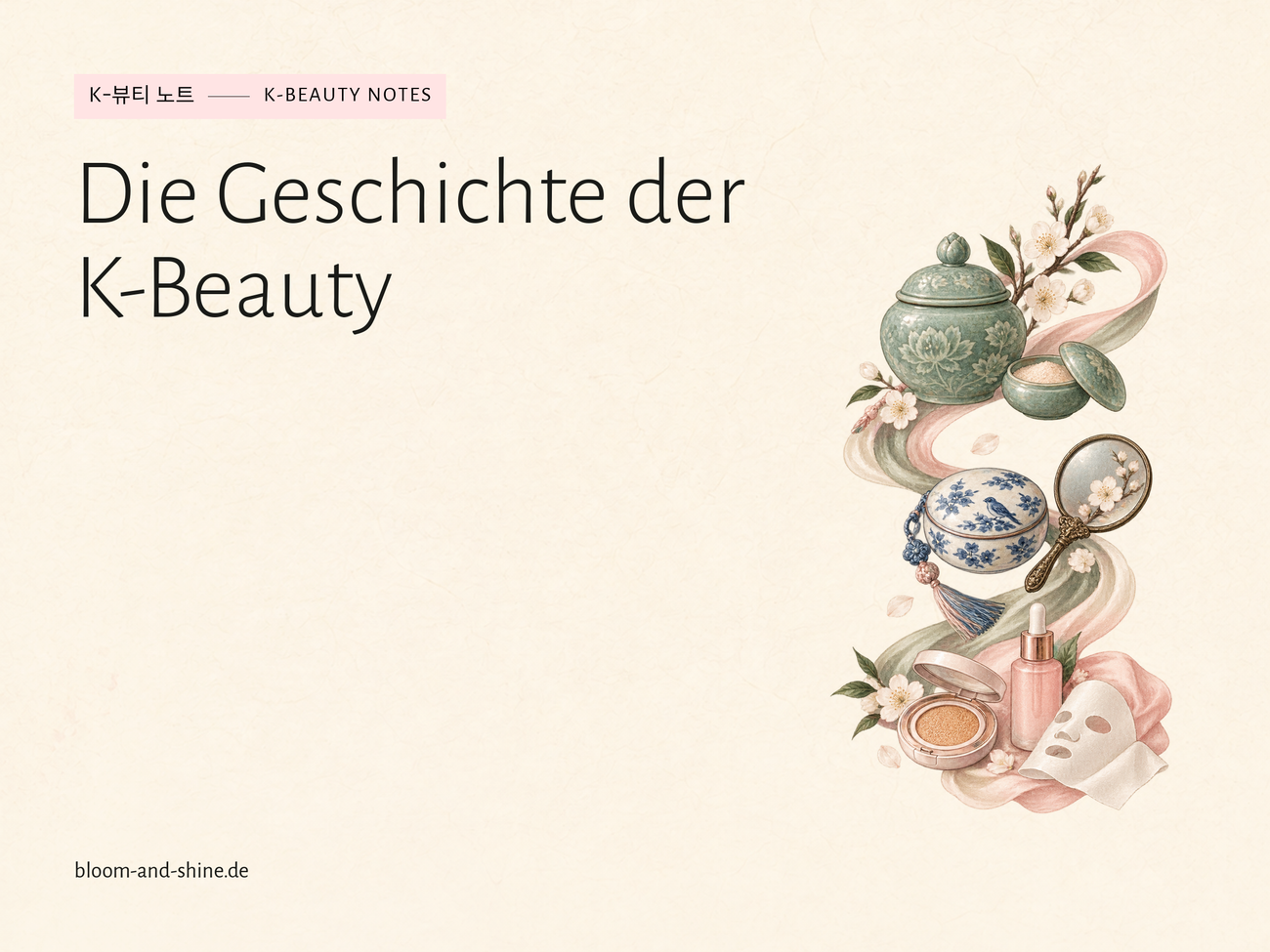
The vessels tell almost as much. Small cans and bottles made of celadon – the shimmering green ceramic for which Goryeo became famous – stored powders, oils or other personal care items. Even back then, an everyday object could be beautiful.
This is perhaps the oldest connection to what stands out about K-Beauty today: content and design are not completely separated.
Joseon: Restraint with beautiful containers
With the Joseon dynasty from 1392 onwards, Neo-Confucian ideas had a greater influence on everyday social life. A controlled, natural-looking demeanor was considered appropriate by many elites. Eye-catching make-up was viewed more cautiously than before.
That didn’t mean beauty disappeared. She shifted. Hairstyles, hair accessories, clothing and finely crafted containers continued to offer scope for design. Small blue and white porcelain boxes, mirrors and combs also turned personal care into a culture of things.
Furthermore, fashions did not only arise at court. Female artists and entertainers known as gisaenginfluenced the clothing, hairstyles, and makeup of their time. Even without social media, people could keep a close eye on who was considered to be setting the style.
As cosmetics became an industry
In the late 19th and early 20th centuries, foreign trade and industrial manufacturing transformed the Korean cosmetics market. During Japanese colonial rule from 1910 to 1945, imported and Japanese products often dominated.
In the 1910s, one of the first Korean mass products appeared with Bakgabun , also called Park’s Powder. The powder was popular and affordable. It was later withdrawn from the market because of its high lead content.
This is also part of the history of beauty: a product can appear modern and still be problematic. Progress isn’t just about new textures. It also needs research, safety testing and better rules.
After the colonial period and the Korean War, an independent South Korean cosmetics industry grew. Companies conducted research and developed new formulations while embracing local raw materials and narratives. One example is ginseng: in 1954, a cosmetics research center was set up at a large Korean manufacturer, and an early ginseng cream followed there in 1966.
Tradition was not simply continued. It was reread in the lab.
The BB Cream came via a detour
One of the most famous K-Beauty stories surprisingly begins in Germany. Christine Schrammek developed a tinted Blemish Balm in 1967. In South Korea, the idea was later taken up, formulated more easily and further developed into a multi-purpose product suitable for everyday use.
The Korean BB Cream combined care, more even color and, depending on the product, UV protection. In the 2000s, it was a good fit for an industry that was rapidly developing and closely monitoring what textures people liked to use on a daily basis.
When BB creams became visible in Europe and North America from the early 2010s, it wasn’t just a cream that traveled. With it came new product terms, application steps and curiosity about an entire care landscape.
K-pop, K-dramas and a very quick mirror
This curiosity met the Hallyu , the Korean wave. Series, music and film made South Korean pop culture internationally present. Singers, actresses and actors became the faces of cosmetic brands. Social media shortened the journey from a scene in Seoul to the bathroom in Berlin to just a few hours.
But stars do not alone explain success. Korean manufacturers were quick to introduce new formats, play with textures and make care easily accessible. Sheet masks, hydrogel patches, sleeping masks and light essences became visible worldwide.
In 2008, the first modern cushion product from Amorepacific was released: liquid foundation, UV protection and care were combined in a special sponge in a compact housing. The idea was practical, well designed and easy to explain. A small can became an ambassador for an entire industry.
And the famous ten steps?
The ten-step routine has shaped K-Beauty abroad. However, it is not an ancient, unchanging ritual that every person in Korea follows completely morning and evening.
It makes more sense as a map: cleanse, moisturize, provide targeted care and protect against UV radiation during the day. How many steps it takes depends on your skin, product, season and patience.
K-Beauty is therefore less a magic number than an attitude to try out. Light layers, pleasant textures, early care rather than late concealment – many of these can be useful. None of this requires a crowded bathroom.
What remains of the journey
The story of K-Beauty is not a tale of ancient knowledge that has been filled unchanged into a modern serum bottle. She is more interesting.
It is about ceramics and chemistry, about court fashion and road shops, about German BB cream and Korean cushion, about pop culture, export and daily habits. Old and new touch each other without becoming the same.
Perhaps this is precisely the strength of K-Beauty: it does not treat care as a rigid legacy. She lets a routine continue learning.
Briefly summarized
Korean cosmetic culture can be traced back to early historical accounts. However, today’s internationally known K-Beauty emerged primarily from the modern South Korean cosmetics industry, technical development and the global spread of Korean pop culture.
Products such as BB cream, cushion, essence or sheet mask became easy-to-understand ambassadors. There is no single beauty ritual for all people in Korea, but rather a changing mix of care, design, research and market.
Sources
- Korean Beauty – The secret for a flawless complexion and perfect glow , chapter “The History of Korean Cosmetics”, pp. 14-21.
- Korea.net: History of Korean cosmetics from the Three Kingdoms to the present
- Korea Magazine: traditional cosmetic culture, Bakgabun and industry development
- VISITKOREA: Cosmetic research and ginseng products since the 1950s
- Dr. med. Christine Schrammek Cosmetics: History of the Blemish Balm
- Amorepacific: Emergence of the modern cushion product in 2008
- Journal of the Korean Society of Costume: K-Beauty, Hallyu and care routines in the global market