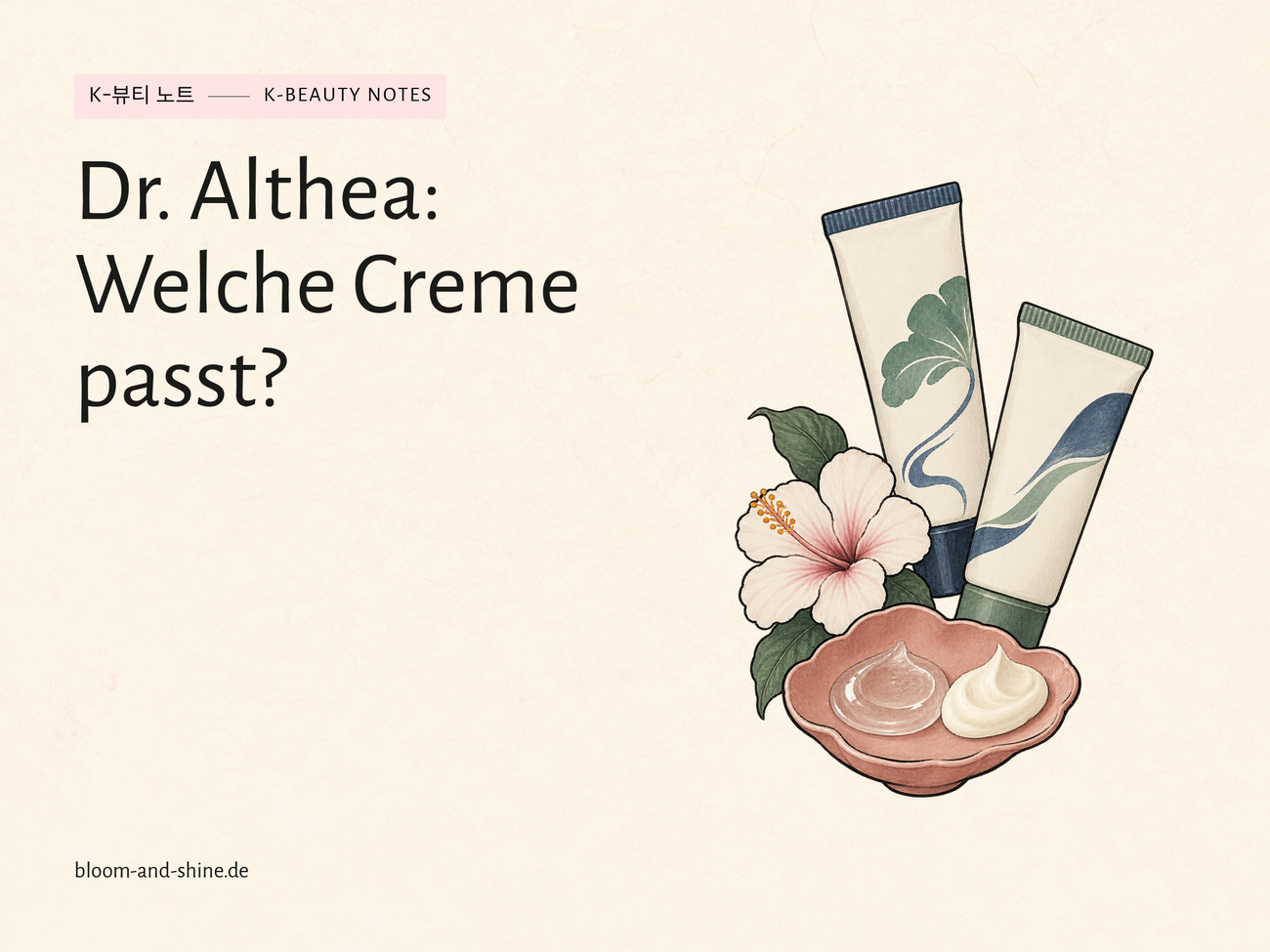
Recognize combination skin and care for it with K-Beauty
The nose shines. The cheeks tense. The forehead wants less cream, while the area around the mouth politely asks for more. Combination skin is not a contradiction. A face is not a uniform...


Recognize combination skin and care for it with K-Beauty
The nose shines. The cheeks tense. The forehead wants less cream, while the area around the mouth politely asks for more.
Combination skin is not a contradiction. A face is not a uniform surface, and care does not have to act as if it were.
How to recognize combination skin
Typically, a greasier T-zone – forehead, nose and often chin – is found over a longer period of time with normal to dry cheeks. In the middle, pores may be more visible and blackheads may appear more frequently. On the sides, however, the skin feels balanced, rough or tense.
Observe this pattern for several days with a familiar, simple routine. If only your nose shines after applying a lot of sunscreen or your cheeks feel tight after a peeling, it doesn’t mean you have combination skin. Then the product can have written the story.
One skin type, several skin conditions
Combination skin can also be generally dehydrated or irritated. Then the T-zone shines while the whole face is tense at the same time. Aggressive cleaning often worsens this condition: the dry areas lose even more protection without the sebaceous glands in the nose permanently disappearing.
Inflamed pustules, painful lumps, severe redness or persistent burning are not just a question of area care. Acne, rosacea, perioral dermatitis and eczema require their own professional classification.
Stabilizing the basic routine
Combination skin doesn’t necessarily need two entire bathroom shelves. A mild common ground and small differences between zones are often enough.
In the morning
- Clean with lukewarm water or a mild detergent.
- Apply a light moisturizing step all over the face if well tolerated.
- Apply a thin layer of gel or lotion texture. There may be a little more cream on dry cheeks and less on the T-zone.
- Finish with a broad-spectrum sunscreen.
In the evening
- Gently remove sunscreen and make-up; clean gently if necessary.
- Apply a light moisturizer.
- Only supplement dry areas with a richer cream.
This is Zone Maintenance . It sounds less impressive than a universal miracle essence. To do this, she follows the face that is actually standing in front of the mirror.
Add at most one targeted active ingredient
If blackheads and clogged pores occur primarily in the T-zone, salicylic acid can be useful there. It is fat-soluble and supports the detachment of horny cells in sebum-rich areas.
Start once or twice a week – and only where it is needed. Dry cheeks do not need to be treated just because they belong to the same face.
If, on the other hand, tension and roughness are the bigger problem, the targeted supplement can be a cream containing ceramide only on the cheeks . This is not a spectacular active ingredient step, but it is often the wiser decision.
First choose a direction: relieve the T-zone or better protect dry zones. If the base feels stable, you can think further later.
Which probably doesn’t help
- Treating the entire face with a strong degreasing cleanser.
- Apply clay or acids daily, even to dry cheeks.
- Very rich cream to spread evenly everywhere.
- Skipping moisturizer completely for fear of shine.
- Distributing several active ingredients in zones at the same time until no one knows what is irritating the skin anymore.
Pores in the T-zone are normal. The goal is not to turn a face into a smooth porcelain surface. It makes more sense to have a routine in which the middle is less congested and the sides are less tense.
In brief
Combination skin typically shows an oilier T-zone and normal to dry cheeks. The areas may be maintained differently.
The sensible approach is: Recognize skin condition, stabilize the basic routine and add at most one targeted active ingredient. Salicylic acid can target the T-zone for clogged pores. Richer barrier care may only be applied to dry areas. Uniformity is not a compulsory subject.
Fact note
- Sebaceous glands are not evenly distributed on the face. The forehead, nose and chin can therefore become more oily than the cheeks.
- Combination skin can be dehydrated or sensitive at the same time.
- Salicylic acid is fat-soluble and keratolytic. It can help with blackheads, but can also irritate dry or irritated areas.
- Moisturizing care does not have to be applied equally generously everywhere.
- Skin type is not a diagnosis. Inflammatory and persistent complaints should be evaluated dermatologically.