Bojagi: Why a cloth is part of the gift
A carefully tied cloth makes a care gift personal. Lee talks about Bojagi and Jogakbo and shows how packaging cloths can be reused.

Bojagi: Why a cloth is part of the gift
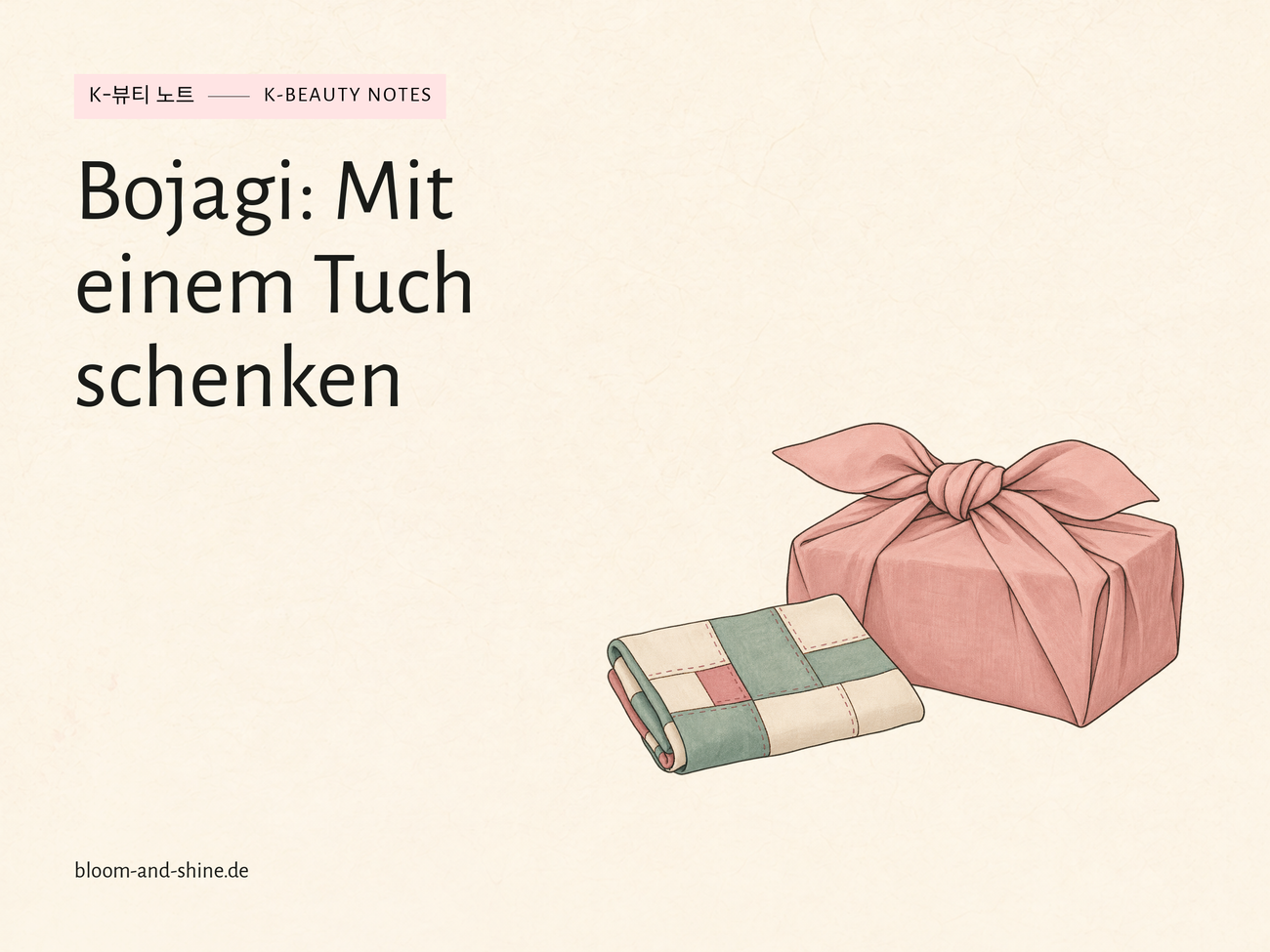
A present lies on the table, wrapped in fabric. The ends of the cloth meet in a knot at the top. When opened, the fabric slides to the side, and after unpacking there is something beautiful there: a cloth that can be used for the next time.
This type of packaging has a long tradition in Korea. The cloths are called Bojagi . They go wonderfully with a carefully selected care gift – and with the idea of showing someone when you give them: I’ve been thinking of you.
What is Bojagi?
Bojagi (보자기) is a Korean collective term for cloths in which things are wrapped. Such cloths could hold objects together, wrap gifts or cover food. They were part of everyday life and were also made for special occasions. To this day, both utility cloths and elaborately designed textile works of art are created. The Metropolitan Museum describes this using a Jogakbo .
An example from the Asian Art Museum shows how personal such a cloth could be: mothers made bojagi for their daughters before their wedding. An object that stored or protected something could be connected to a person and an important moment at the same time.
Good wishes could also become visible in the design. The Met contains a silk scarf with symbols for double happiness and a pair of phoenixes , which, according to the museum, probably wrapped a wedding gift. Such meanings belong to the respective cloth and occasion; they cannot be assigned to every node or every color.
Jogakbo: When small pieces of fabric come together
Maybe you have already seen a cloth whose surface is made up of rectangles and color fields of different sizes. This patchwork shape is called Jogakbo (조각보) . To do this, small pieces of fabric are sewn together until a new, larger area is created. So not every Bojagi is a Jogakbo.
The Victoria and Albert Museum describes how scraps of fabric from the production of Korean clothing were used for such work. The cloths preserved material into which work had already gone. At the same time, the combination created its own patterns: a narrow strip connects two larger areas, and a small piece next to it adds a color accent.
You can discover a lot about it, especially if you take a closer look. The seams show how the cloth is constructed. A jogakbo can therefore be a gift in itself that one enjoys looking at and keeping. By the way, a printed patchwork pattern is different than a jogakbo sewn together from individual pieces.
Why a scarf makes giving gifts so personal
Choose your favorite color, smooth the fabric, slip a small card under the knot: When wrapping, there are opportunities to think about the person receiving the gift. This attention becomes visible when you hand it over. You don’t need a large package or a particularly elaborate bow.
A familiar cream whose jar has just run out can be a very thoughtful gift. Wrapped in the cloth, it gets its own little appearance. Maybe the card also says why you chose this particular product.
If you give the cloth as a gift, feel free to say so. A sentence like “The scarf is yours too – maybe you’ll use it to wrap a gift someday” takes away the uncertainty about whether you should return it. And it already provides an idea for later.
This is how you can wrap a care gift in fabric
A small, sturdy box is particularly suitable for starters. Choose a clean, sufficiently large cloth that is preferably square: the opposite corners should be easy to knot over the gift. With an existing cloth you can first try out which size fits.
- Spread out: Place the cloth face down on the table, with one corner facing you. Place the gift in the middle.
- Close the first pair: Bring the corner facing you and the opposite corner over the gift and tie them.
- Bring the sides together: Place the two remaining corners over them and tie them together as well. Tighten the knots so that the package holds together and can be opened again later.
- Arrange in peace: Smooth out the folds and align the ends. A card can be pushed under the top node.
This is an easy way to get started with fabric packaging. Depending on the shape of the gift and the nature of the cloth, other folds work better. Cosmetics remain in their original closed packaging. Several products are supported in a suitable box; With glass, you support the gift from below when carrying it.
Which K-Beauty products fit in?
A cream jar, lip balm or a small care set can easily be included in such a gift packaging. If the recipient already likes to use it, the Beauty of Joseon Dynasty Cream , for example, could be the right choice. For someone who likes lip masks, consider the Laneige Lip Sleeping Mask EX .
Be guided by your preferences and previous care. A surprise doesn’t have to be a completely new routine. If you are unsure about the product selection, you can ask via Ask Thu . A brief description of what the person likes to use is helpful.
After unpacking: This is how the cloth can be reused
The best thing is when the cloth is used again soon. Depending on the size, material and workmanship, there are different options:
- Wrap the next gift. Folded up, the cloth next to the gift cards waits for its next use. It can also pass on to another person.
- Keeping small things together. When traveling, you can bundle hair ties or a soft hair band in it.
- Designing a space at home. Patterns and colors remain visible under a jewelry bowl or as an insert in a small basket. The place should be dry for this.
- Wear it as an accessory. A sufficiently soft scarf can be suitable as a hair or neck scarf if the size and material are suitable. Delicate seams or decorations should not come under tension.
How the cloth can be washed or ironed depends on its care label. For us, the idea of reuse is, above all, that a cloth actually finds a place in everyday life. If you already have a suitable one, you can start with it. A newly purchased cloth is not only environmentally friendly because it replaces wrapping paper.
Soon also at Bloom & Shine
We would like to enable you to give this kind of gift soon at Bloom & Shine and are planning wipes for wrapping your care gifts. As soon as our offer is available, we will introduce you to the cloths with their sizes, materials and suitable packaging ideas.
We like the idea of leaving something out of the box that can be used. Maybe the same cloth will later wrap a birthday present or lie under a small bowl in the bedroom. It then becomes part of the everyday life of the person you chose it for.
Lee’s fact note
- Bojagi refers to Korean wrapping and wrapping cloths. They could be made for specific people or occasions. Asian Art Museum
- Jogakbo is the shape of pieces of cloth sewn together. The Met assigns their distribution to, among other things, the late Joseon period. Metropolitan Museum
- Leftover fabric from the production of Korean clothing was used for jogakbo. Victoria and Albert Museum